The School follows the core curriculum of the Department of Education and Science for the final two years of primary school, the three years of the
Junior Cycle, Transition Year and the two years of the Senior Cycle. However there are significant differences in delivery of this curriculum and the School also embraces aspects of a wider curriculum which are central to the John Scottus system of education, including a
Spiritual Education.
Speech and Language:
.jpg) |
“Speech is a mirror of the soul; as a man speaks, so is he” – Publilius Syrus.
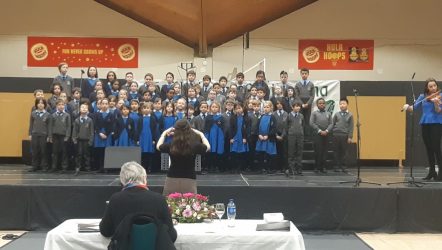
Mastery of speech is fundamental to good education. Therefore, the spoken and written word have a high profile in John Scottus. In keeping with the aim that the School gives its students the best and finest works that our civilisation and culture can offer, there is an emphasis on Shakespeare, ancienct and classical literature and inspiring modern texts. The School stages dramatic plays annually, as well as holding debates and speech competitions. We encourage all pupils to express truly what they think and believe on all occasions. |
The Classical Languages:
The School teaches
Sanskrit, Greek and Latin. The aim is to acquire the orderliness of mind that comes with mastering grammar and translation, together with the values inherent in the literature and philosophy of these great languages. The study of grammar helps train the mind so that it can be applied to other subjects with greater efficiency. The School’s Classics teachers make a significant contribution to the support of Classics in Ireland.
Art:
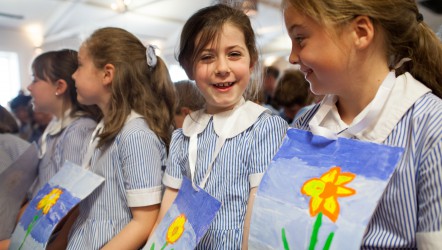
The strength of John Scottus’ approach to this subject lies in its emphasis on drawing and painting from life. The Art Department is a great outlet for creativity and expression of beauty, a necessary part of every student’s education, and an essential part of their future life for a number of them.
Although John Scottus takes a broad view of education and believes that success in education is measured by much more than results in public examinations, nonetheless it strives for academic excellence. The school has an excellent record in public examinations, with the vast majority of its students going on to University and third level colleges.
Read about some of the recent achievements of our students.
Assessment Methods in the Secondary School
- Homework – emphasis is placed on the content and the presentation of work. Feedback is given. The School Homework Policy outlines the expected frequency and quantity of homework which should be expected in the Junior and Senior Cycle, as well as sanctions for non-completion of homework.
- 3-weekly tests and Midterm tests are held in class time in all academic subjects. Reports are sent to parents with Grades and Effort marks.
- End of Term and End of Year tests are time-tabled with longer tests. Reports are sent to parents with Grades, Effort marks and Qualitative Feedback/ Comments from each teacher.
Senior School Speech and Prize-giving Night
The Senior School Speech and Prize-giving Night is one of the highlights of the Summer Term each Year. Prizes are awarded for both academic excellence and student commitment to their studies in each subject.
State Examinations - Junior Certificate and Leaving Certificate
The Junior and Leaving Certificate Curricula are developed by the National Centre for Curriculum and Assessment, and the curricula details can bo accessed on-line at the NCCA's Curriculum Online website. Information on State Examinations can be accessed on the State Examination Commission website
The Junior Cycle
All pupils study these subjects to Junior Certificate level:
Junior Certificate Examination Subjects
| English |
Irish |
Mathematics |
| History |
Geography |
Science |
| Art |
Latin |
Classical Studies |
| Ancient Greek |
French |
CSPE |
Subjects not examined at Junior Certificate but taught by the School:
• Sanskrit (up to and including 2nd Year)
• Philosophy and SPHE
• Music (some pupils may take Music in Junior Certificate)
• Sport
The Senior Cycle
The following subjects are currently offered at Leaving Certificate level:
Leaving Certificate Examination Subjects
| English |
Irish |
Mathematics |
| Physics |
Chemistry |
Biology |
| French |
History |
Geography |
| Latin |
Ancient Greek |
Business |
| Classical Studies |
Art |
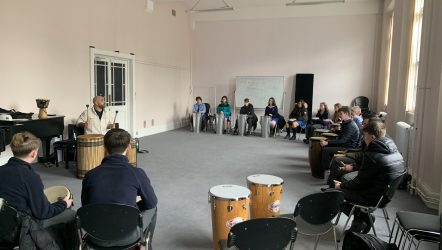
Music |
 |
John Scottus School is a strong supporter of Transition Year, and it is mandatory. By the end of Transition year the pupils have grown in maturity, and they focus more easily on the forthcoming Leaving Certificate Cycle.
The John Scottus Transition Year Curriculum has been developed and evolved over the last number of years, continuously improving and expanding. The programme is quite distinctive and reflects the ethos of the school.
Transition Year Homepage. |
“Strength does not come from physical capacity but from an indomitable will.” Mahatma Gandhi
.jpg) |
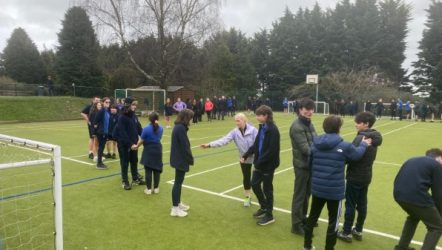
Sport in John Scottus is based on team games which promote team spirit and sportsmanship as well as fitness and skill. The school's team sports are hockey for the girls, and soccer and hockey for the boys. There is also an Athletics Club for boys and girl. The School took a decision to include sport as much as possible inside the normal school timetable, even if it lengths the day a little. There are two double-period Sports classes each week.
Sports Home Page.
|
Lunches - A hot vegetarian lunch is served each day to all the pupils and its cost us covered in the school fees that parents pay.
Teachers as Learners:
The key to inspiring pupils is to give them the best material available – give them goodness, and they become good. Like all good teachers, those in John Scottus look for opportunities to enrich the subjects they teach with inspiring material: to do this, the teachers themselves must continue to study their own subjects and develop a glorious vision for what they teach. Pupils are invigorated by the infectious enthusiasm of the teachers.
Secondary School Academic Staff List for Academic Year 2009/10
Learning Support and Resource teaching for pupils who need extra help is provided by a small department which complements the normal academic programme.
Career Guidance is provided for 4th, 5th and 6th years. Students are encouraged to find the subject they most love, and then to map a route through third level education, or elsewhere as appropriate, and on to a satisfying career. The 5th and 6th Class Teachers, the Director of Studies and the Career Guidance teacher all have roles to play in this, as do the parents.
Director of Studies for 5th and 6th Year: The role of the Director of Studies is to direct the academic work of the Senior Cycle, to see that the students can achieve at the highest standard of which they are capable.
D.E.S. School Inspections
The Secondary School is subject to inspection by the Department of Education School (D.E.S.) Inspectorate and to date there have been three Subject Inspections (History, French and Irish), and the reports are published on the DES website.
Read the Subject Inspection executive summaries, and access the detailed reports.
The School’s approach to
Information Technology is to use it to enhance the learning experience in all subjects, as appropriate. To facilitate this aim, the school uses wireless, mobile computer technology rather than a static computer lab. There are data projectors in all rooms and lessons are frequently conducted using digital resources and Internet content. Teachers continually update their IT skills, and the school is committed to the development of on-line teaching and learning resources on the school's
Moodle website. This form of learning also increases the students’ competence with IT and effective Internet Research, which will be essential for third level education and in their working life.
Field Trips: Many cultural sites in the North and South of Ireland and across Europe are visited by the Art, History, Geography and other Departments.
Look at some samples of class and field trips.

International research has shown that when parents are involved in their child's educational life, their children achieve better outcomes through their school years. Unity of approach between parents and the teachers is considered vital in John Scottus School. The importance of this relationship is expressed in frequent meetings between parents and teachers in both formal and informal settings.
There are annual Parent / Subject Teacher meetings and Parent/ Class Teacher meetings arranged each year. Parents are encouraged to contact Class or subject teachers if there are concerns about their child’s performance or to discuss their aspirations for or needs of their child.